Personality Type Test (16 Types)
Discover your leanings across 16 MBTI-like types with 40 public-domain research items (IPIP); results show as percentages on four axes. Not the official MBTI.
Loading the tool…
Used this tool? Share what worked for you — it helps the next person.
Personality Type Test (16 Types): complete guide
Walk through the steps and examples, or jump straight to the topic you need.
At a glance
- Questions
- 40 items in total, 10 each for extraversion, openness, agreeableness, and conscientiousness, taken from the IPIP Big-Five Factor Markers (public domain), a set of items published for research.
- Progress
- Five pages of 8 questions each. You answer each statement on a 5-point scale from "Disagree" to "Agree", and it usually takes about 5 minutes.
- Result
- For each of the four axes, it shows which way and how much you lean as a percentage, and marks 45-55% as borderline. The four-letter type is shown for reference only.
- Storage
- Your answers are saved only on this device (in your browser) so you can continue later, and they are not sent to a server. They are cleared when you press "Start over" or "Retake."
- Result card
- You can save the result as a 1080×1350 image, share it directly on supported devices, or copy it as text.
- Relation to the official test
- It is not the official MBTI assessment and is not affiliated with Myers-Briggs. It does not replace a psychological diagnosis.
How to use Personality Type Test (16 Types)
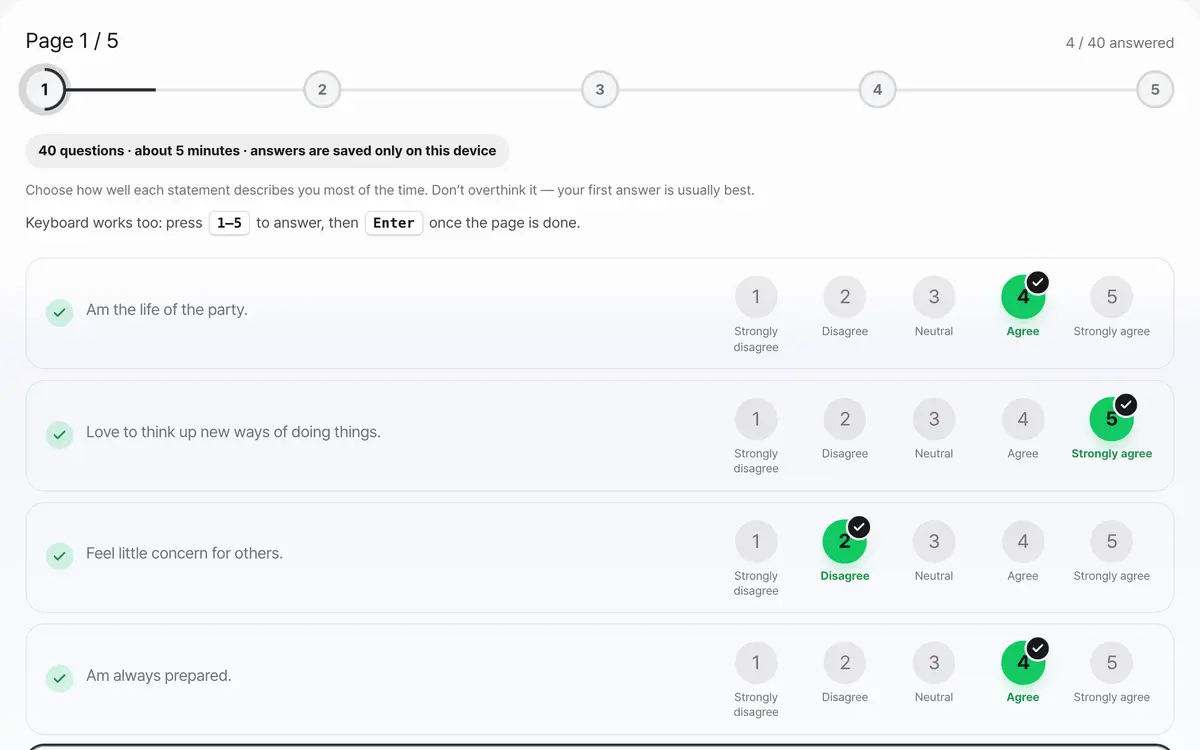
Answer 40 statements on a 1–5 scale, 8 per page
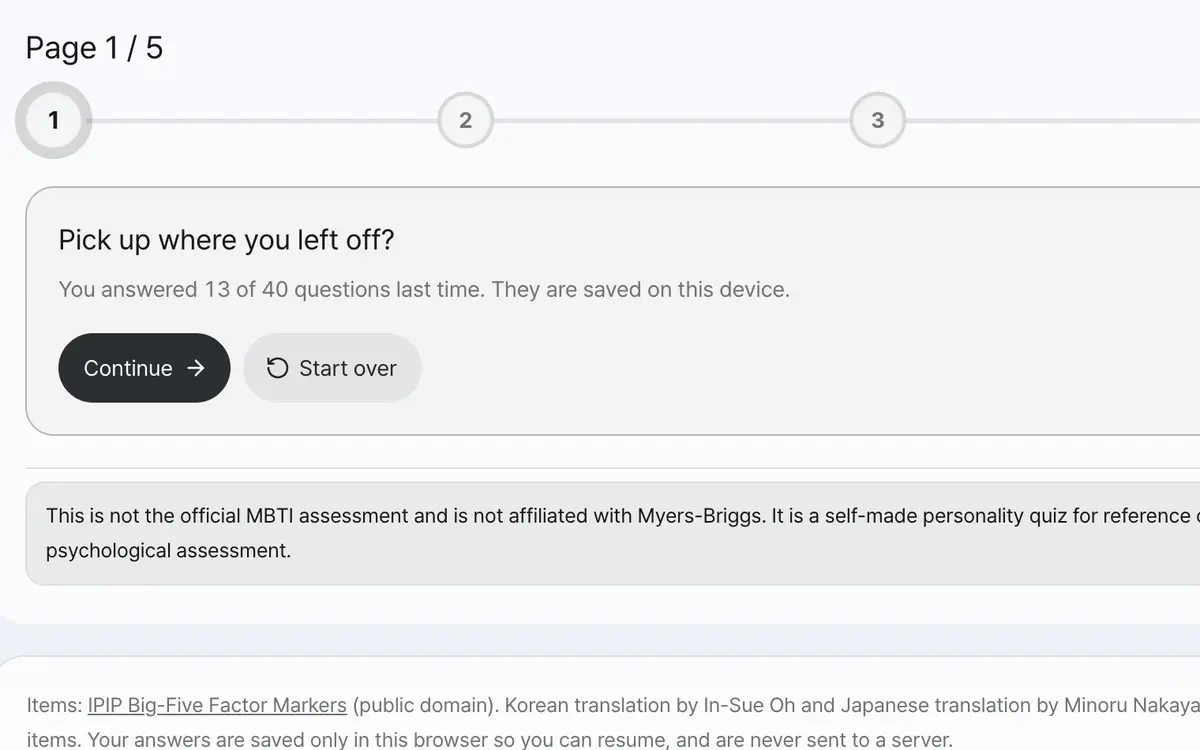
Answers are saved on this device, so you can change them or pick up later
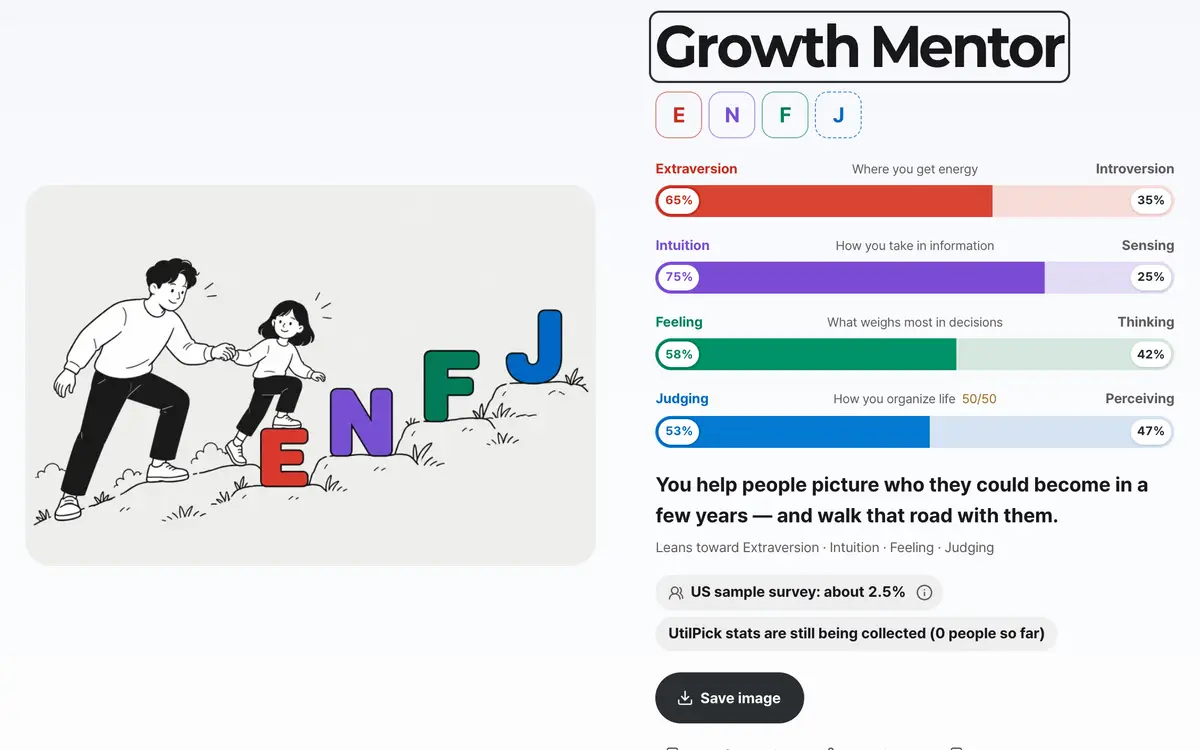
Check the percentages on four axes and your closest type, then save the result card
Answer as you are when you feel at ease
For each statement, tap one of the five circles to show how well it fits you in everyday life. The far left means "Disagree," the far right means "Agree," and the circles get larger toward the ends. After you answer, the screen moves on to the next question.
Finish one page, then move on
When you have answered all 8 questions, the Next button is highlighted. Your answers stay as they are if you go back to an earlier page, so you can change them any time. On the keyboard, press 1-5 to answer and Enter to go to the next page.
Look at the percentage on each of the four axes first
Once you have answered all 40 questions, your result appears. Look at the percentage on each axis before the four-letter type. The further it is from 50%, the clearer that tendency is, and 45-55% is borderline, close to both sides.
Save the result card or try again
You can keep your result with Save image, Share, or Copy result. If you close the window partway through, you can pick up where you left off when you return; to start over, press Retake.
What it’s good for
How the test works
There are 40 questions in all, 8 per page across five pages. For each statement, pick how well it fits you in everyday life on a 5-point scale from "Strongly disagree" to "Strongly agree". It usually takes about 5 minutes. You can go back to earlier pages to change answers, and you need to answer all 40 questions to see a result. The result shows a percentage for each of the four axes and the four-letter type closest to you, and you can save the result card as an image.
What the four axes mean
Energy direction (Extraversion E ↔ Introversion I) looks at whether you recharge by being with people or by spending time alone. The way you take in information (Intuition N ↔ Sensing S) looks at whether you are drawn to ideas and possibilities or trust facts and direct experience. The weight you give when deciding (Feeling F ↔ Thinking T) looks at whether you consider people's feelings and relationships first or logic and standards first. Lifestyle (Judging J ↔ Perceiving P) looks at whether you prefer to plan and keep things organized or to stay flexible and adapt to the situation.
How to read your result
Look at the percentage on each axis before the four letters. The further it is from 50%, the clearer that tendency is; the closer to 50%, the more you move between both sides depending on the situation. A result of 45-55% is marked as "borderline." In that range a few different answers can flip the letter, so it is better not to define yourself by a single letter. Neither side is better or worse. They are just different directions you lean toward.
Tips for answering accurately
Answer as you are when you feel at ease, not as you want to be or as your workplace or school expects you to be. Rather than agonizing over a statement, your first instinct is usually more accurate. If you choose "Neutral" too often, several axes may come out as borderline. It is normal for results to shift a little depending on your condition or recent circumstances.
Questions and sources
The test uses 40 items for extraversion, openness, agreeableness, and conscientiousness from the IPIP Big-Five Factor Markers (public domain, ipip.ori.org), published for research use. The Korean translation is the public version by In-Sue Oh and the Japanese translation is the public version by Minoru Nakayama; some items were adjusted to match the original meaning. Three openness items that ask about intellectual ability, such as vocabulary and comprehension, were replaced with IPIP items about imagination and curiosity. Emotional stability items are not used because they do not match the 16-type axes.
How the four axes are calculated
Extraversion maps to the Extraversion (E) ↔ Introversion (I) axis, openness to Intuition (N) ↔ Sensing (S), agreeableness to Feeling (F) ↔ Thinking (T), and conscientiousness to Judging (J) ↔ Perceiving (P). Research has found that these four personality factors are fairly closely related to the four axes of the 16 types. Each axis has 10 items scored 1-5; reverse-keyed items are converted to 6 minus the score, and the average is expressed as (average − 1) ÷ 4 × 100%. 50% or more gives the first letter, and 45-55% is marked as borderline.
Differences from the official MBTI assessment
This test is not the official MBTI assessment and is not affiliated with Myers-Briggs. It is our own personality test for reference only, and because the items and scoring differ, your result may not match the official one. It shows your tendencies using names for 16 similar types, but it does not reproduce the official type descriptions.
Things to keep in mind when using your result
It works well as a light starting point for self-understanding and conversation. However, it is not a substitute for a psychological diagnosis or counseling, and it must not be used as the basis for important decisions such as hiring, evaluation, or career choices. Rather than pinning someone down to a single type, use it to talk about which ways of working feel comfortable to each of you.
Worked examples
Calculating the percentage for one axis
Sum of the 10 extraversion item scores: 33 (1-5 points × 10 items)Extraversion 58% · Introversion 42% → EA reverse-keyed item
"I am a person of few words" answered "Strongly agree" (5)Extraversion score: 1A borderline axis
Feeling 52% · Thinking 48%F (borderline)How to read the percentage ranges
Swipe the table sideways to see the rest.
| Range | Meaning | How to read it |
|---|---|---|
| 45-55% | The two tendencies are nearly equal | You tend to show both sides depending on the situation. Don't settle on a single letter. |
| 56-70% (or 30-44%) | A slight lean to one side | That side feels comfortable day to day, but the opposite side also comes fairly naturally. |
| 71% or more (or 29% or less) | A clear tendency to one side | That way of doing things feels much easier. Using the opposite approach when needed may take a bit more effort. |
When the result isn’t what you expected
I can't click See result
The result does not appear while any question is unanswered. Missing questions are highlighted, and if some are on another page, you are taken to that page.
The Continue option doesn't appear
Your answers are saved only in the same browser. In a private (incognito) window, a different browser or device, or after clearing site data, you start from the beginning.
There is no image share button
It only appears on devices that support file sharing (mostly phones). On a PC, download the image with Save image and upload it yourself.
Number keys don't answer
Number keys are ignored while the cursor is in an input field or after you clicked outside the test screen. Click the question area once and try again.
Key terms
- Axis
- A scale connecting two opposite tendencies, such as Extraversion ↔ Introversion, Intuition ↔ Sensing, Feeling ↔ Thinking, and Judging ↔ Perceiving.
- Borderline
- When the result on one axis is 45-55%, meaning the two tendencies came out nearly equal.
- Reverse-keyed item
- A statement that asks about the opposite trait of the axis. Its score is calculated as 6 minus the answer.
- IPIP
- The International Personality Item Pool. A set of personality items published for research that anyone may use.
Personality Type Test (16 Types) FAQ
Is it the same as an official MBTI result?
No, it should not be considered the same. It is our own test built from public academic items (IPIP), and it only shows your tendencies using names for 16 types similar to MBTI. If you need an official result, take a test from a certified provider.
How long does it take?
With 40 questions, it usually takes about 5 minutes. It is split into five pages of 8 questions each, and your progress is shown on screen.
My type changes every time I take it.
On an axis marked as borderline (45-55%), a few answers can change the letter. Looking at the percentages instead of the letters shows which way you lean and how much. It is also normal for results to vary slightly with your condition or recent circumstances.
What does "borderline" mean?
It means the two tendencies on that axis came out nearly equal (45-55%). You can read it as showing both sides depending on the situation.
Is it okay to choose "Neutral"?
It is fine when you truly feel 50/50. But the more you choose it, the more your results cluster near 50% and the more borderline axes you get. If you lean even slightly one way, picking that side gives a clearer result.
Can teenagers take it too?
Anyone can try it, but the items are research items designed for adults. Treat it only as a reference for fun and self-understanding.
Can I take it in English or Japanese?
Yes. If you switch the display language to English or Japanese, you can take the test with the English original or the Japanese translation of the same items.
Are my answers saved or sent to a server?
Your answers are saved only on this device (in your browser) so you can continue later, and they are not sent to a server. The result card is also created inside your browser. For the "what percent of UtilPick respondents" statistics, only the four-letter type of the result is counted anonymously once a day. Your saved answers are cleared when you press "Start over" or "Retake."
Can I continue on another device?
No. Your answers are saved only in the browser you took the test in. On another device, you need to start from the beginning.
Why is emotional stability not in the results?
Of the five IPIP personality factors, emotional stability does not match the four axes of the 16 types, so its items were left out.
How do I delete my saved answers?
Press "Retake" on the result screen or "Start over" in the continue prompt, and the answers saved on this device are cleared.